Process
Components of a process: PC - store memory
OS uses many techniques to maximize utilization of the CPU
OS is responsible for:
-
Creating and deleting both user and system processes
-
Suspending and Resuming processes
-
Process Synchronization
-
Deadlock Handling
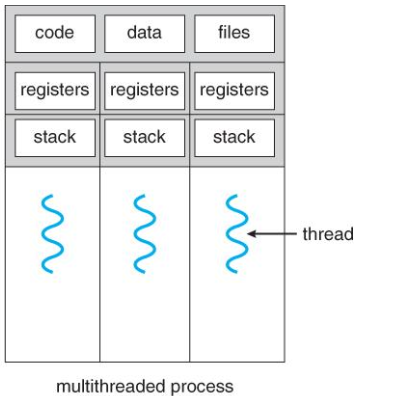
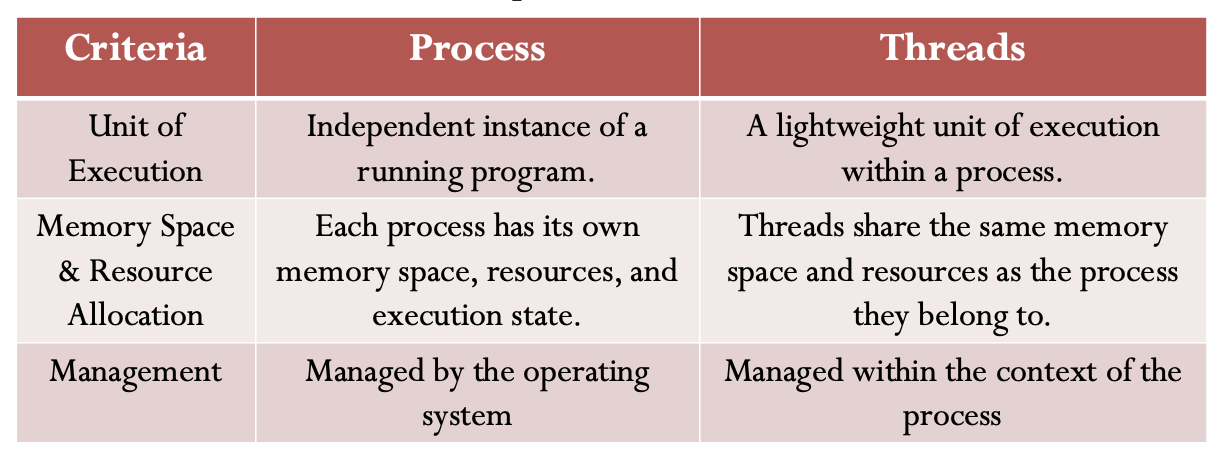
Multithreading
Interrupts
- Interrupt recieved
- Address for appropriate ISR found in interrupt vector
- Save address of interrupted instruction and CPU state in registers
- Incoming interrupts disabled whilst interrupt is being serviced (prevent lost interrupt)
Processor
Multiprocessors:
- Increased throughput
- Economy of scale
- Increased reliability
Types of multiprocessing:
- Asymmetric Multiprocessing
- Symmetric Multiprocessing
Symmetric Multiprocessing Architecture
A multiprocessor system where multiple processors share a single main memory and have equal access to all I/O devices
- Processors run same operating system instance
- peer-level no master/slave
Clustered Systems
- multiple computers sharing the same storage
- high-availability, survives system failures
Types:
- Asymmetric Clustering - one machine in hot-standby mode
- Symmetric Clustering - multiple nodes running applications, monitoring each other
OS Tasks: Timesharing CPU Scheduling Process Swapping (RAM ←> Secondary Storage) Virtual Memory
I/O Structure
Synchronous I/O - control returns to user program AFTER I/O completion:
- CPU (using wait instruction) enters a wait loop until the next interrupt
- Only 1 I/O request can be accessed